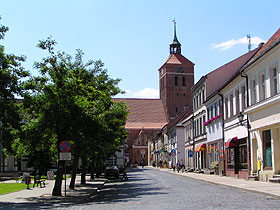
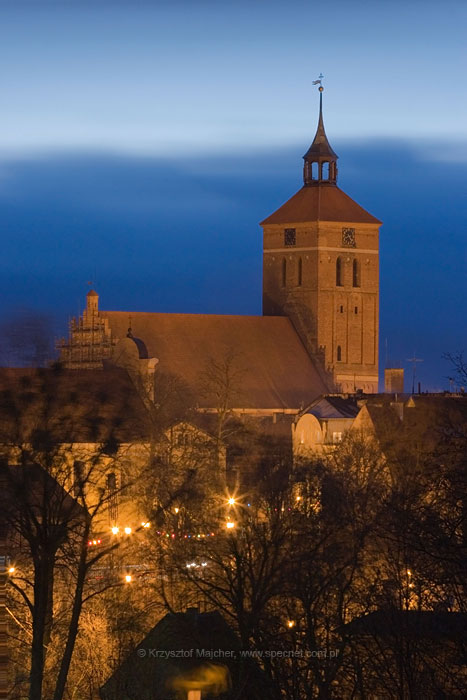
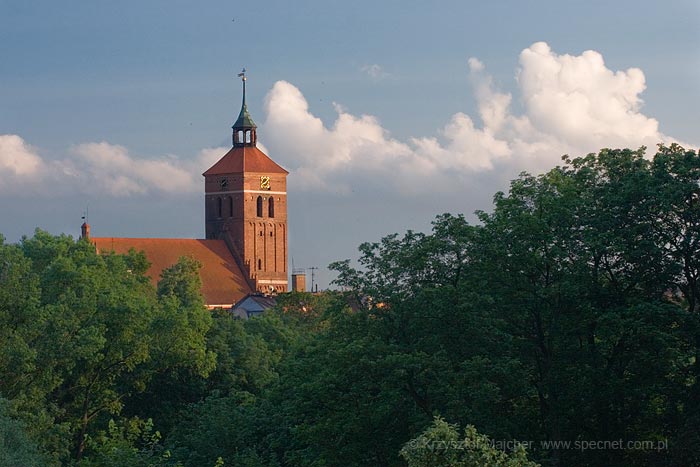
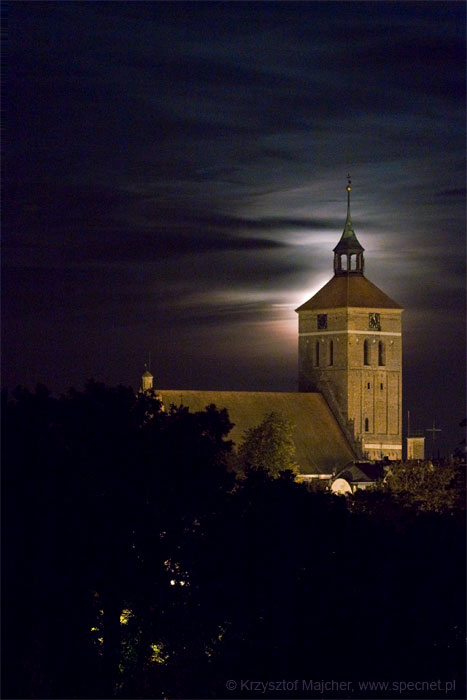
14th century church and its tower
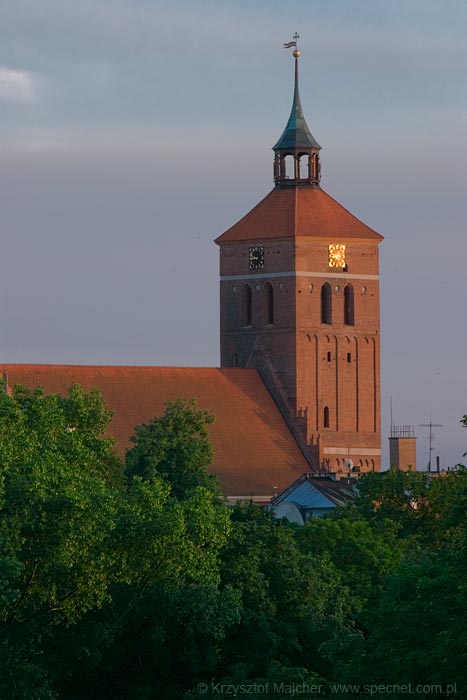
The 51.2m church tower is well worth climbing. One can admire a beautifulpanorama of Reszel from the top.
Sightseeing
The 51.2m church tower is well worth climbing. One can admire a beautifulpanorama of Reszel from the top.
The tower is open from 9 am to 5 pm. Tickets 4 zł adults and 2 zł children/students.
History
The parish in Reszel was established as early as 1337 (it was then mentioned for the first time and the oldest note about the parson comes from that year), however the church itself was probably wooden and no document mentioning it has survived until today.
The hall
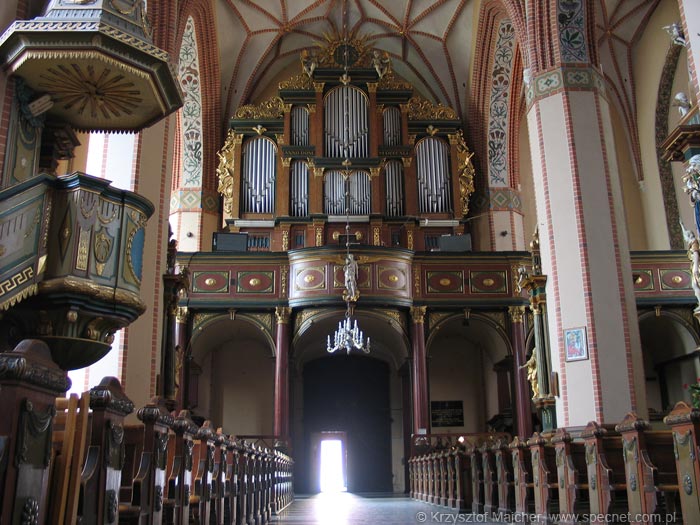
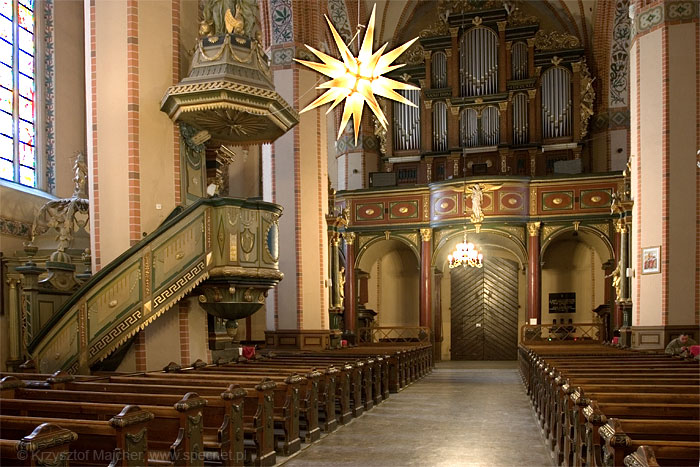
The church known today dates back to 2nd half of 14th century. It’s gothic, its main entrance faces the west, build from brick and stone (the base), of a rectangular shape with a square, 8 floor tower in the west. It consists of the main nave, 2 aisles and 5 bays (spans). The starry vault was built by Nielis Schewnermann between 1475 - 1476.
In the northern side a storeyed vestry and a starry vault church-porch was built on to the church main body. Later a narrow, baroque annex was added between the vestry and the church-porch.
In the eastern side a ground-floor, barrel vault library was built in 1471.
The tower
The tower was built together with the church, rebuilt in 1482 - 1487, 1495 - 1503, the top floor and the roof dating back to 1837 was designed by Joachim Zagroziński. In 1920 a new staircase by the northern church-porch was built replacing the gothic one from 1489. At the tower base there is a church-porch rebuilt in 1921. At first open on four sides. Nowadays pointed-arched entrances in the north and south are walled up. The eastern head of the main body was completed after 1475.
The whole church is clamped, on the corners the clamps are placed diagonally.
Portals
- The main, in the west, on the side of the church-porch
- From the church porch to the nave
- Outside on the northern church-porch
- From the northern church-porch to the nave
- From the nave to the baroque annex
- From the nave to the vestry
All pointed-arched portals have richly decorated jambs dating back to 2nd half of 14th century. In the portal to the vestry one can see a wooden door with metal bars with decorative fittings and the lock-15th century.
The fittings and the lock in the northern church-porch door is baroque. Outside in the recess above the portal of the northern church-porch there is a late baroque sculpture of a passion group.
In the eastern wall recess one can admire a figure of Holy Mary with a child dated 1st half of 19th century. Classical iterior decoration from 1820 – 1844.
Altar
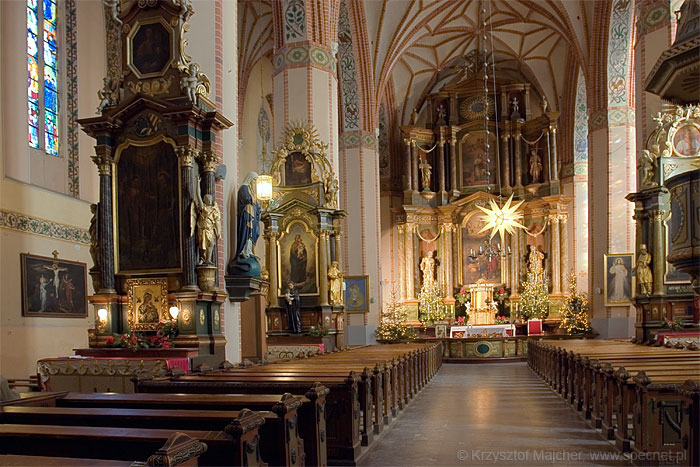
The main altar was founded by the Warmia bishop Józef von Hohenzollern; it was completed between 1820 - 1822 by a sculptor Wilhelm Biereichela and a joiner Andrzej Thiel, painted and gold-plated in 1853 by J. Strunge.
The paintings: 1) saint Piotr i Paweł and 2) saint Katarzyna were painted in 1821 by Antoni Blank from Warszawa. The four figures of the disciples date back to 17th century and come from the main altar of a post-Jesuit church. The tabernacle with a throne in rococo style was made by B. Schmidt in 1767. A joiner Andrzej Thiel made the balustrade in 1818.
The two aisle altars were made between 1823 - 1825 by Wilhelm Biereichel, analogical, architectonical, two-storeyed with figures of angels; in the left one at the top a relief –Resurrection, and in the right altar- Assumption (painted by Blank but now replaced by other ones).
The four altars by the second and third pair of pillars were completed by Karol Ludwik Biereichel from 1843 to 1844; they were painted and gold-plated by J. Strunge (from1854 to 1857).
Translation Marcin Samborski